Loading game
Preparing player
Loading game

Ready to play
Slope is a fast 3D endless runner where you steer a rolling ball past gaps and red obstacles as the track speeds up. Learn controls and useful tips.
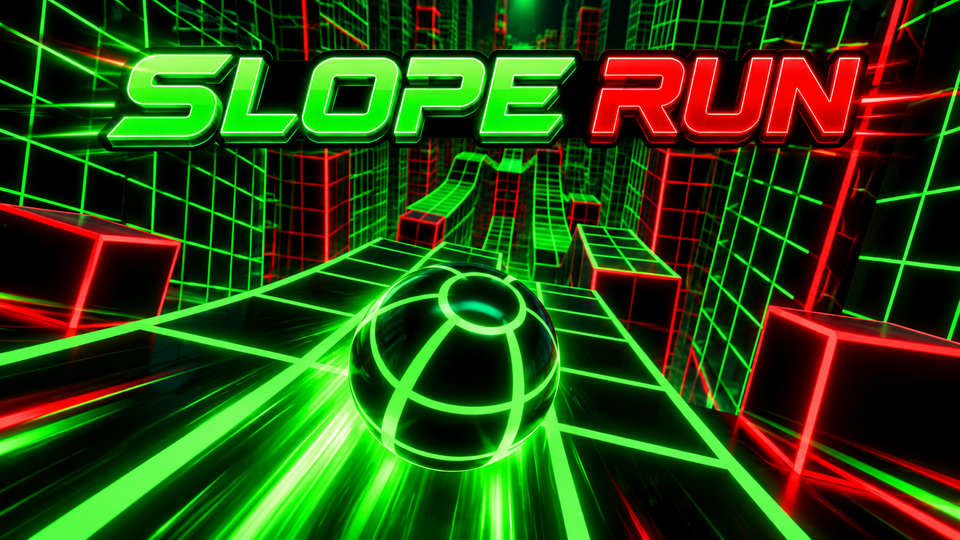
Slope is a fast 3D endless runner where you steer a rolling ball down a suspended track filled with gaps, sharp turns, narrow sections, and red obstacles. The ball moves forward automatically, so your job is not to control its speed but to keep it on the course for as long as possible.
Every Slope run becomes harder as the ball accelerates. A small steering mistake that is easy to recover from at the beginning can send you off the track later at high speed. Your score increases as you travel farther, and the run ends when the ball falls from the course or collides with a dangerous obstacle. Y8's current game page confirms the left/right steering, increasing speed, endless format, and red hazards described across the supplied competitor material.
The core idea is simple: keep the ball moving down the track without crashing. There is no traditional finish line to reach. Instead, success is measured by how long you can survive and how far you can travel before making a mistake.
The track constantly forces you to adjust your position. Some sections are wide enough to make small corrections, while others narrow suddenly or place hazards directly along your path. Gaps can separate platforms, turns can change the direction of the course, and red blocks create areas that must be avoided completely.
The challenge grows naturally because the ball becomes faster as the run continues. This means Slope does not need complicated enemies, upgrades, or objectives to increase the difficulty. The same two steering controls become increasingly demanding as your reaction window gets shorter.
The most important change as you improve is learning to steer proactively. Beginners often react only to what is directly beside the ball. Stronger runs come from reading the next section of track before entering it.
The controls are deliberately minimal:
There is no separate jump button in the standard gameplay described by the available sources. Momentum and the shape of the track determine how the ball crosses drops and transitions, while you concentrate on horizontal positioning.
Speed is the main source of pressure. Early in a run, there is enough time to make a correction after drifting toward an edge. Later, the same correction may need to happen almost immediately.
Wide platforms give you room to recover. Narrow tracks do not. Entering a narrow section from a poor angle can make the next turn much harder even if you avoid falling immediately.
Red hazards must be treated differently from ordinary track geometry. Instead of simply staying on the platform, you need to identify a clear route around the obstacle before reaching it.
Some sections of the course are separated by gaps or changes in elevation. Because forward movement is automatic, your main responsibility is lining up the ball so its momentum carries it toward the next safe platform.
The faster the ball becomes, the less useful large emergency movements are. Overcorrecting near an edge can send the ball across the track and off the opposite side.
At higher speeds, holding a direction for too long is risky. Tap left or right to make controlled corrections instead of forcing the ball across the entire track. Small movements are especially important on narrow platforms.
Your ball remains in a predictable part of the screen, so you do not need to stare directly at it. Focus farther down the slope. Seeing an obstacle earlier gives you more time to choose which side to pass.
A central position usually gives you more options. If the next obstacle requires a move to either side, starting near the center means you need less steering distance than if you are already close to an edge.
This does not mean forcing the ball back to the center after every turn. If the next safe route is already on one side, unnecessary recentering can create another problem.
Do not make a large directional change at the final moment before leaving a platform. Try to establish the correct line first, then use smaller corrections as the ball approaches the transition.
One of the biggest changes between an early and late Slope run is how much steering you can safely use. The faster you travel, the more sensitive each correction becomes. A movement that was harmless at the start may become excessive later.
Reacting too late is one of the main reasons runs end. Waiting until a red obstacle fills the screen leaves very little room to choose a safe path.
Holding a direction too long is another frequent problem. Players may avoid one hazard successfully but continue steering afterward, causing the ball to leave the opposite side of the platform.
Trying to center the ball constantly can also create unnecessary movement. The best position is the one that prepares you for the next section, not always the exact middle of the current platform.
Watching only the nearest obstacle makes combinations harder. A safe route around one block can immediately lead toward a gap or another obstacle. Scan farther ahead whenever the track is visible.
Slope uses very few mechanics, but each one directly affects survival. There are no complicated commands to memorize and no long setup before another attempt. The difficulty comes from controlling momentum as the pace increases.
That creates a clear improvement loop. A failed run usually shows exactly what went wrong: steering too far, reacting late, approaching a gap from the wrong angle, or entering a narrow section without enough space. The next attempt gives you an immediate opportunity to correct that mistake.
The endless format also makes personal scores meaningful. Instead of completing a fixed sequence and moving on, the objective remains the same while your ability to handle higher speeds improves.
The goal is to guide the rolling ball as far as possible without falling from the track or hitting dangerous obstacles. Your score increases as the run continues.
The supplied sources describe Slope as an endless runner rather than a level-based game with a final finish line. A run continues until you crash or fall from the track.
The ball accelerates as you survive longer. Faster movement leaves less time to react to turns, gaps, narrow sections, and obstacles.
Contact with a red obstacle ends the current run, so identify a clear route around these hazards before reaching them.
Make smaller steering corrections, look farther ahead, and position the ball for upcoming sections rather than reacting at the last second. Maintaining control becomes more important than making aggressive movements as speed increases.
Slope becomes difficult because the controls never become more complicated while the consequences of every movement become larger. Read the track ahead, enter narrow sections from a controlled angle, avoid unnecessary steering, and treat each correction more carefully as the ball accelerates. Improving those fundamentals is the most reliable way to extend your next run and push your score farther.
LIVE CHAT
No messages yet. Start the conversation.
Log in to join the chat.
Login