Loading game
Preparing player
Loading game
Ready to play
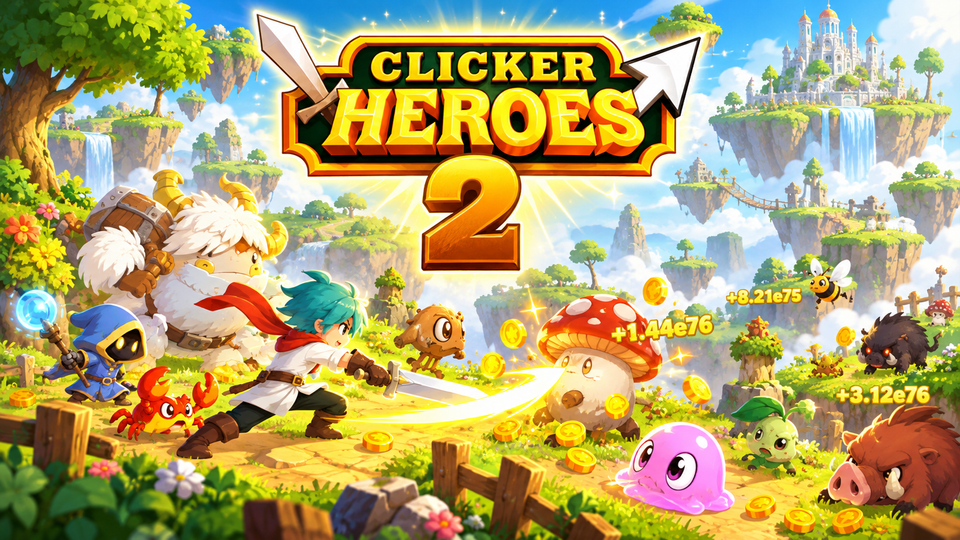
Clicker Heroes 2 is an incremental action RPG where you defeat monsters, upgrade gear, build skill trees, automate combat, ascend, and explore new worlds.
Clicker Heroes 2 is an incremental action RPG from Playsaurus where one hero automatically travels through zones, fights monsters, earns gold and experience, equips stronger gear, and unlocks increasingly powerful skills. Unlike the first Clicker Heroes, which revolves heavily around recruiting a large roster of heroes, the sequel puts much more emphasis on developing an individual character through equipment, active abilities, a large skill tree, automation, worlds, Ascension, and Transcension.
Playsaurus released Clicker Heroes 2 into Steam Early Access on July 16, 2018. Development never reached the planned 1.0 release, and Playsaurus announced in March 2024 that the game would be removed from sale on Steam. Players who already own it can still access their copy.
Your hero moves automatically from enemy to enemy. Monsters drop gold that can be spent on weapons, armor, and other equipment, while defeated enemies also provide experience. Leveling up gives you access to additional character progression through the skill system.
The immediate goal is to increase your damage fast enough to keep clearing zones. Better equipment increases your statistics, while skills let you create stronger combinations involving manual clicks, automatic attacks, critical damage, energy, mana, and other effects.
Progress extends beyond a single map. Worlds contain groups of zones and increasingly strong monsters, while later systems organize those worlds into larger Star Systems. The game is structured as an ongoing incremental journey rather than a campaign with one final ending.
Clicker Heroes 2 combines automatic combat with manual mouse and keyboard input. Cid can perform manual click attacks with the mouse or W key, while Space pauses automatic actions. Most equipment, skill tree, Automator, and progression management is handled through the interface.
Gold is constantly reinvested into equipment. Moving into a harder zone without enough damage slows kills, which also slows gold and experience gain. Buying stronger gear helps restore your clearing speed.
This creates a continuous progression loop: kill monsters, earn currency, improve equipment, increase damage, then move into stronger enemies that require another round of upgrades.
Do not wait too long to improve weak equipment simply because you are saving for one expensive purchase. Incremental games reward production speed, so an affordable upgrade that lets you defeat enemies noticeably faster can help pay for later items sooner.
The skill system is one of the largest differences between Clicker Heroes 2 and its predecessor. Skills such as Big Clicks, Huge Click, MultiClick, and other abilities can dramatically change how your character deals damage. The original Steam description highlighted hundreds of progression choices and an expansive skill tree.
The system changed substantially during Early Access. In the major 0.18 update, Cid's skill tree was redesigned so that the first skill point selects one of four specializations. That choice provides the central tools of that build and determines which section of the tree remains available until the next Ascension.
Because of this structure, skill points should support one coherent plan. Combining upgrades that strengthen the same damage source is generally more useful than spreading points across unrelated mechanics.
Active abilities are not unlimited. Skills can consume Energy or Mana and may also have cooldowns. For example, MultiClick produces several clicks from one activation, while other abilities enhance upcoming attacks or provide resource-management effects.
This prevents rapid clicking from being the only strategy. Spending Energy too quickly can leave important abilities unavailable when you reach a stronger enemy or boss.
Watch which resource your build depends on and avoid triggering abilities without considering their cost. A skill rotation that produces slightly less immediate damage but remains sustainable can outperform one that empties your resources after a few enemies.
The Automator is one of Clicker Heroes 2's defining mechanics. Instead of merely increasing passive DPS, it lets you create rules that automatically perform actions when specific conditions are satisfied. The official Steam description lists automatic gear leveling, purchases, and skill combinations among its uses.
Automator setups combine conditions with actions. A condition might check whether Energy is low, whether a cooldown has finished, or whether a monster's health meets a certain threshold. The corresponding action can then activate a skill or buy equipment.
A well-designed Automator should support your build rather than simply activate everything as soon as possible. Put important resource recovery and damage combinations under conditions that prevent them from interfering with each other.
Progress is organized into worlds, with each world containing 100 zones according to the community documentation. Environments, monster health, and other conditions vary as you travel farther. Groups of worlds form Star Systems, which become important to Ascension and Transcension progression.
Bosses serve as important progression checks. If normal monsters fall quickly but a boss takes too long, the problem is usually damage efficiency rather than navigation. Review gear, available skills, and automation before repeatedly pushing the same encounter.
The later Early Access build replaced Ethereal Items with Artifacts. Forge Cores drop from bosses and can be spent in the crafting system to create and upgrade Artifacts. Unlike ordinary equipment that is frequently replaced, Artifacts provide longer-term progression value.
This gives boss progression another purpose beyond unlocking the next zones. Clearing stronger encounters contributes resources that can improve future runs through persistent equipment systems.
Ascension resets parts of your current progression so you can rebuild with longer-term bonuses. Later versions award World Crumbs from completed worlds, and Starfire can be used as part of the Ascension system. The skill tree is rebuilt during a new cycle, giving you another opportunity to choose how the character develops.
Transcension sits above Ascension as a larger prestige layer. The final major 0.18 update allows Transcension after sufficient Star System progression and rewards Hero Souls used for broader long-term improvements.
The general rule for both systems is similar: reset when the permanent benefit is likely to make rebuilding faster than continuing to push a run that has slowed significantly.
The 0.18 update introduced two difficulty settings. Casual Mode reduces the need for highly optimized mathematical decisions, while Difficult Mode is designed around more careful build planning and efficient progression.
This choice changes how strictly you need to optimize skills and resources, but the same core progression remains: improve your character, automate increasingly complex actions, and reach farther worlds.
Choose skill nodes that reinforce the same set of abilities. A focused build is easier to automate and gives your upgrades a clearer purpose.
If ordinary monsters suddenly take much longer to defeat, check equipment before assuming you need an entirely different build. Gear is the main short-term source of additional damage.
Manual clicks and active skills can consume Energy. Leave enough resources available for the abilities that produce the largest part of your damage.
Use the Automator for actions you would otherwise repeat constantly, such as equipment purchases and skill activation. Save manual attention for build decisions and progression choices.
If new equipment and levels require increasingly long waits, compare that progress with the permanent benefit available from an Ascension. A well-timed reset can accelerate the next cycle.
The original Clicker Heroes centers on recruiting and leveling a large roster whose combined DPS automatically kills monsters. Clicker Heroes 2 instead develops individual characters through equipment, active skills, build choices, and programmable automation.
The sequel also uses a more complex RPG structure involving worlds, skill trees, resources, Artifacts, Ascension, and Transcension. It therefore requires more build planning than simply purchasing the next hero whenever enough gold becomes available.
If you enjoy incremental growth, automated progression, and upgrading damage over long runs, try these related games on YaloGames:
Clicker Heroes 2 is an endless incremental action RPG developed and published by Playsaurus. It combines automatic combat with equipment, skills, worlds, character builds, and automation.
The game entered Steam Early Access on July 16, 2018.
The Automator lets you create rules that automatically activate skills, buy equipment, and perform other repetitive actions when specific conditions are met.
Yes. Later builds use Ascension as a progression reset, while Transcension provides a larger long-term prestige layer involving Hero Souls.
No. Playsaurus announced the retirement of Clicker Heroes 2 in March 2024, and the Steam store now states that it is no longer available for purchase. Existing owners retain access.
Clicker Heroes 2 expands incremental progression into a more involved character-building system. Keep gear strong enough to maintain fast kills, choose skills that support one another, manage Energy and Mana carefully, and gradually teach the Automator to handle repetitive combat and purchases. The farther you travel through worlds and Star Systems, the more important it becomes to combine short-term equipment upgrades with Ascension, Artifacts, and other permanent progression systems.
LIVE CHAT
No messages yet. Start the conversation.
Log in to join the chat.
Login