Loading game
Preparing player
Loading game
Ready to play
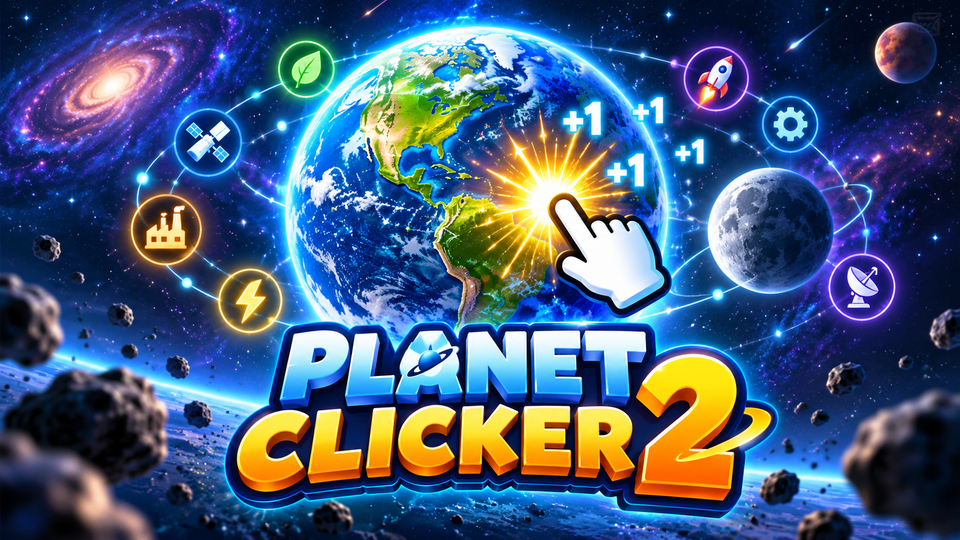
Planet Clicker 2 is an idle space game where you generate energy, buy automated upgrades, unlock new planets, and expand production toward Neptune.
Planet Clicker 2 is an incremental idle game where you click planets to generate energy, spend that energy on production upgrades, and gradually expand beyond Earth into new parts of the solar system. The sequel keeps the basic click-and-upgrade loop of the original Planet Clicker while adding more planets, technologies, longer progression, and updated visuals.
The game was developed by Coltroc and released in January 2022. Unlike the original Scratch-based Planet Clicker, the sequel was built in Unity 2020. CrazyGames lists its latest recorded update as April 2023.
Every run begins on Earth. Clicking the planet manually produces energy, which serves as the main resource for progression. You can reinvest that energy into upgrades that strengthen manual production or generate energy automatically.
As passive production grows, manual clicking becomes less important. Farms, power plants, and other technologies begin producing energy every second, allowing the economy to continue increasing without every unit coming directly from your mouse.
The main long-term objective is expansion. Accumulate enough energy to unlock another planet, then use the stronger technologies available there to increase production again. The sequel is significantly longer than the original and extends its progression outward through multiple worlds, ultimately reaching Neptune.
The verified desktop control is extremely simple. CrazyGames documents the left mouse button as the primary input used to generate energy from planets.
Earth introduces the basic economy. You begin with direct clicking before moving into increasingly automated production using familiar technologies such as farms and power plants.
The important transition is from energy per click to energy per second. Improving manual clicks can accelerate the first few purchases, but automatic production becomes increasingly valuable because it keeps generating resources regardless of how quickly you click.
Once your automatic production becomes strong enough, treat clicking as an extra boost rather than the foundation of the entire economy.
Planet progression is more than a visual change. Each new world provides access to additional resources and technologies with greater production capacity. CrazyGames specifically identifies Mars as introducing energy sources such as oil, nuclear power, and Martian technology.
This means repeatedly purchasing old Earth upgrades may eventually become less efficient than saving for the next stage of planetary progression. When a new world becomes reachable, compare its production opportunities before committing large amounts of energy to older equipment.
The original Planet Clicker contains only Earth, Mars, and Venus. Planet Clicker 2 expands that structure substantially, with six worlds extending as far as Neptune according to current comparisons of the two Coltroc games.
| Game | Progression |
|---|---|
| Planet Clicker | Three worlds ending at Venus. |
| Planet Clicker 2 | Six worlds with progression extending to Neptune. |
The additional worlds make the sequel a longer incremental climb. Your numbers continue growing, but the costs required for each new stage also rise significantly.
Incremental games become much faster when purchases begin paying for future purchases. An automatic producer does not only increase your current score—it also shortens the time required to afford every upgrade that follows.
This is why your energy-per-second rate is often more useful than the total energy displayed on screen. A large balance tells you what you can afford immediately, while production rate tells you how quickly you will reach the next milestone.
When two upgrades are available, compare the increase they provide rather than automatically buying the cheaper one.
Click upgrades can be valuable early because you are already interacting constantly with the planet. However, manual clicking has a practical limit: your energy generation stops when you stop clicking.
Automated production does not have that limitation while the game's systems are running. Once farms, power plants, and later technologies provide substantial output, passive production becomes the more important engine behind expansion.
Use manual clicks to accelerate short waits, but build your economy around systems that continue producing energy on their own.
Turn your first manual earnings into passive production as soon as the available upgrades make that practical. Every automatic producer contributes toward later purchases without requiring another click.
Do not choose an upgrade only because it has the lowest price. A more expensive technology can be a better investment when it produces substantially more energy per second.
If another world is almost affordable, avoid spending the entire balance on minor improvements. Unlocking a new planet can provide access to a stronger group of technologies.
An Earth producer that once transformed your economy may become relatively weak after you reach a planet with much stronger energy systems. Shift spending toward the technologies that now provide the largest production gains.
If automatic production has brought you close to the next upgrade price, manual clicking can help finish the remaining amount. This is more efficient than treating clicking as your only long-term source of energy.
The original Planet Clicker was released in 2020 and built with Scratch. It uses a shorter three-world progression consisting of Earth, Mars, and Venus. Planet Clicker 2 followed in January 2022 as a Unity-based sequel with redrawn visuals, additional planets, more technology, and a longer progression path.
The central gameplay idea remains familiar: click for energy, automate production, reinvest your earnings, and expand. The sequel simply gives that loop considerably more room to grow.
If you enjoy clickers, idle production, and space-themed progression, try these related games on YaloGames:
Planet Clicker 2 is an incremental space game where you generate energy, buy production upgrades, and unlock additional planets across the solar system.
Planet Clicker 2 was developed by Coltroc.
The game was released in January 2022 and its latest recorded CrazyGames update was in April 2023.
Click planets with the left mouse button to generate energy manually, then buy technologies that increase production and automate the process.
The sequel uses Unity instead of Scratch and expands the original three-world game into a longer progression with six worlds reaching as far as Neptune.
Planet Clicker 2 turns the simple act of clicking Earth into a much longer resource-management loop. Build automatic energy production early, compare upgrades by the growth they provide, save intelligently for new planets, and shift investment toward stronger technologies as your reach expands. The farther you travel through the solar system, the less important raw clicking becomes and the more important efficient production decisions become.
LIVE CHAT
No messages yet. Start the conversation.
Log in to join the chat.
Login