Loading game
Preparing player
Loading game
Ready to play
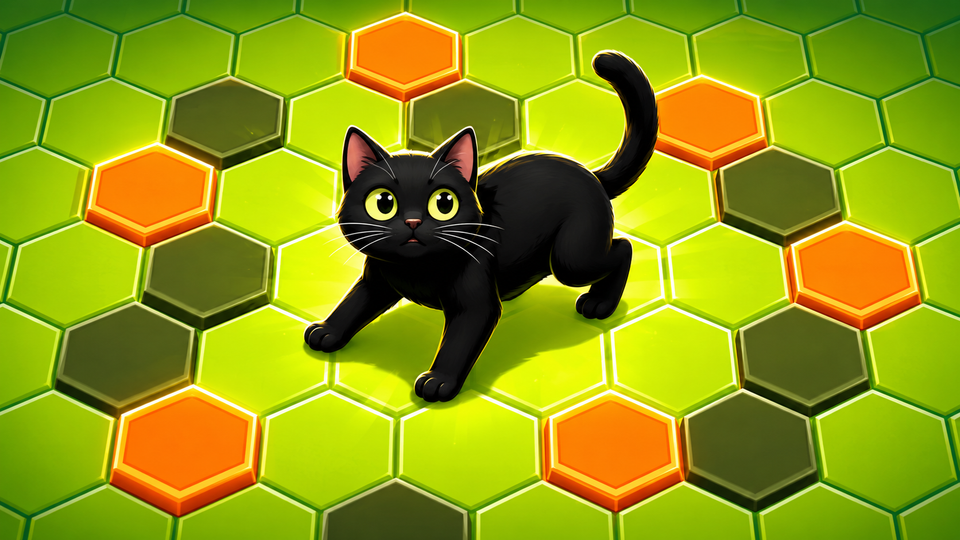
Trap the Cat is a strategic grid puzzle where you place barriers, predict the cat’s moves, and close every route before it reaches the edge.
Trap the Cat is a turn-based logic puzzle where you must surround a clever cat before it reaches the edge of the board. The cat begins inside a honeycomb-style grid, and every cell you block removes one possible route. After each move, the cat advances to a neighboring open space, so the challenge is not simply placing barriers—it is predicting where the cat will go next.
The rules take only a moment to understand, but winning consistently requires careful planning. Clicking random cells usually leaves an open corridor to the border. A stronger strategy is to build a wide perimeter, restrict the most dangerous escape routes, and gradually reduce the cat’s available movement.
The board is made of connected spaces arranged in a hexagonal pattern. The cat can move between neighboring open cells, while blocked cells function as walls. You and the cat take alternating actions:
You win when every neighboring cell around the cat is blocked and it has nowhere to move. You lose as soon as the cat reaches an open cell on the border and escapes from the board.
Each placement therefore has two purposes. It should reduce the number of available paths while also influencing the direction the cat chooses. A well-positioned barrier can do more than stop one step—it can force the cat toward an area that is easier to close.
Start by examining the full board rather than focusing only on the cells beside the cat. Look for broad routes connecting its current position to the outer edge. Those corridors are the immediate danger, especially when they contain few existing barriers.
Click an open cell to block it. The cat will respond immediately by moving one space. Reassess the board after every turn because its movement may create a new threat or reveal a useful bottleneck.
Your objective is to complete a closed perimeter before the cat crosses it. The enclosure does not need to be small at first. In fact, beginning with a wider boundary usually gives you more time to react. Once the cat is contained within that area, you can safely close the remaining spaces.
There are no movement keys to manage. Every decision is made by choosing the next cell to close, allowing the gameplay to focus entirely on board analysis and route prediction.
A common beginner mistake is placing barriers directly beside the cat. This may block its current direction, but the cat can often turn and run through another open corridor. Starting farther away gives you room to form a complete boundary before the cat reaches it.
Think of the board as two zones: the inner area where the cat can move and the outer area leading to freedom. Your first goal is to disconnect those zones with a rough ring of blocked cells.
Count how many moves separate the cat from each side of the board. A route with only a few open cells is more urgent than a long path filled with obstacles. Close the shortest escape lane first, then check whether the cat has changed direction.
Do not assume it will continue moving in a straight line. Each barrier can make another route more attractive, so compare all open paths after every turn.
Pre-blocked cells are useful parts of your enclosure. Instead of trying to build an entire cage from nothing, steer the cat toward a cluster of barriers and complete the missing side.
For example, if several blocked cells already form a partial wall on the left, close routes on the right and encourage the cat to move toward that wall. You will need fewer placements to finish the trap.
A bottleneck is a narrow passage connecting two larger open areas. Blocking the correct cell inside that passage can eliminate several possible escape paths at once.
Before placing a barrier, check how many routes depend on that cell. Closing a central connection is usually more valuable than blocking an isolated space that the cat may never use.
Once the cat appears nearly surrounded, it is tempting to block the closest available cell. First confirm that the wider enclosure has no gap. The cat only needs one connected path to the border to escape.
Complete the outer boundary, then reduce the interior one cell at a time. This controlled approach is more reliable than repeatedly chasing the cat around the board.
There is no universal sequence that solves every board. Consistent wins come from evaluating distance, connectivity, and available barriers rather than memorizing fixed clicks.
Before each move, ask three questions:
This short check prevents impulsive moves. It also helps you treat the cat’s position as only one part of the puzzle. The structure of the entire grid matters more than the single cell it currently occupies.
The Trap the Cat game gives you only one barrier before the cat moves again. You cannot create a complete cage in a single turn, which means every enclosure must be built while the target is actively changing position.
The cat also benefits from open space. Near the center, it may have several possible directions, making its next move harder to predict. As the perimeter becomes smaller, its behavior becomes easier to read—but only if you have already blocked its access to the edge.
This balance creates short rounds with meaningful decisions. A single poor placement can ruin an otherwise strong setup, while one carefully chosen bottleneck can turn a difficult board into a successful trap.
Click or tap empty cells to turn them into barriers. After every placement, the cat moves to a neighboring open cell. Surround it before it reaches the edge of the grid.
Create a closed perimeter with no connected route to the border. Once the cat has no open neighboring cell, the round is won.
Close barriers may stop one direction without removing the cat’s other escape routes. A wider enclosure limits several paths and gives you more control over where the cat moves.
No. The opening arrangement can vary, so you need to identify the shortest routes and useful bottlenecks on the current board.
Prioritize routes leading to the edge instead of chasing the cat’s current position. Controlling the board is more effective than reacting to one move at a time.
Trap the Cat turns a single-click control scheme into a compact strategy challenge. Examine the full grid, build a perimeter before tightening it, and use existing barriers to reduce the number of moves required. When every route has been closed and the cat can no longer advance, your plan is complete.
LIVE CHAT
No messages yet. Start the conversation.
Log in to join the chat.
Login