Loading game
Preparing player
Loading game
Ready to play
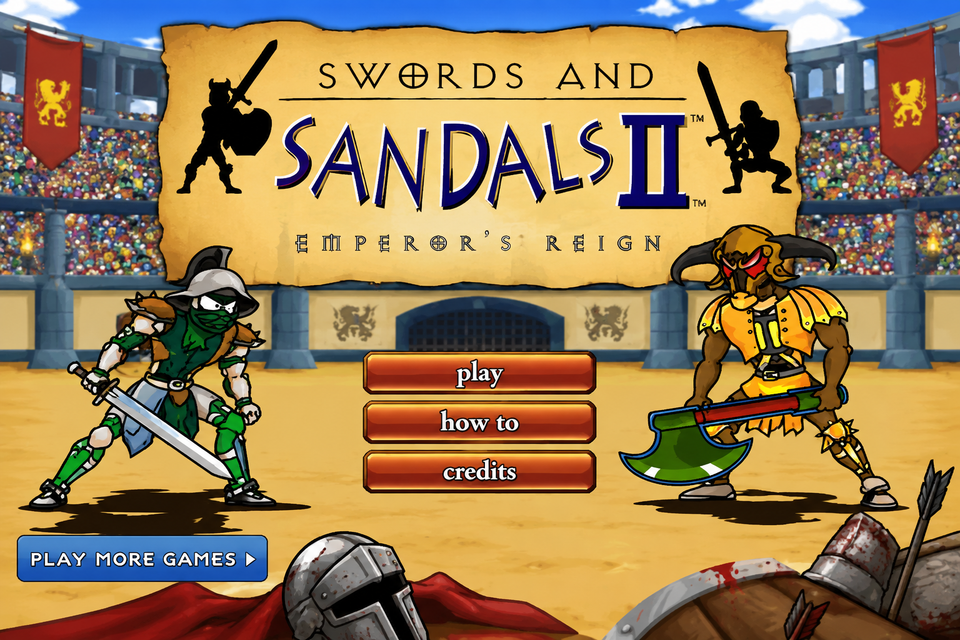
Swords and Sandals 2 is a turn-based gladiator RPG where you build a fighter, buy weapons and armor, use magic, and battle arena champions.
Swords and Sandals 2: Emperor’s Reign is a turn-based gladiator RPG where you create a fighter, distribute attribute points, buy weapons and armor, and battle increasingly powerful opponents in the arenas of Doomtrek. Every action in combat uses a turn, so victory depends on managing distance, stamina, equipment, attack accuracy, defense, and special abilities rather than simply clicking the strongest attack repeatedly.
The sequel adds ranged weapons, magic, larger equipment systems, new tournaments, and a long series of Arena Champions leading toward Emperor Antares. The original browser sequel was released in January 2007, with the Newgrounds release describing new tournaments, ranged weapons, spells, and powerful champions.
You begin by creating your gladiator and distributing points among several attributes. After an introductory battle, you gain access to Doomtrek’s town, where you can enter arena fights or spend your gold in shops.
Combat is turn based. On your turn, you choose an action from the battle interface. You can move closer, retreat, attack with a melee weapon, use a ranged weapon, taunt, rest, or activate available magic and consumable items. Your opponent then receives a turn.
Winning battles gives you gold and experience. Gold is spent on equipment and supplies, while leveling allows your gladiator to improve attributes. Tournament progression introduces stronger fighters and Arena Champions, so a build that handles early opponents may need better armor, accuracy, stamina, or magic later.
The classic game is controlled through a point-and-click interface. Character creation, town navigation, shopping, and arena combat all use the mouse.
Your stat distribution determines which equipment you can use and how your gladiator performs in combat. Swords and Sandals 2 uses eight main attributes.
| Attribute | Main Purpose |
|---|---|
| Strength | Raises physical damage and helps qualify for strength-based weapons. |
| Agility | Improves movement and helps unlock agile and ranged weapon options. |
| Attack | Improves your chance of successfully hitting an opponent. |
| Defence | Improves your ability to avoid or defend against attacks. |
| Vitality | Increases the gladiator’s health. |
| Charisma | Supports crowd and taunt-related mechanics and influences parts of the game economy. |
| Stamina | Increases the energy available for movement and combat actions. |
| Magicka | Provides access to increasingly advanced magical options. |
You do not need to raise every attribute equally. A gladiator built around ranged weapons will value different statistics from one designed around heavy melee attacks or high Magicka. The important part is making your attributes support the equipment and actions you actually use.
After earning gold, you can visit different shops around town. The weapon shop sells melee and ranged weapons, the armor shop provides protective equipment and shields, and magical services allow weapons to gain elemental effects. Potions can restore resources during difficult fights.
Armor is especially important because it absorbs incoming punishment before your health is exhausted. Different equipment pieces also support different parts of your gladiator’s defense, while shields are useful against ranged attacks. Stronger equipment often comes with level or stat requirements, so character development and shopping are closely connected.
Weapons can also be enchanted with magical effects. These additions give your attacks another source of damage and can introduce effects such as fire, frost, poison, or fear-related magic.
Gladiators fight on an arena floor rather than remaining fixed in place. Moving consumes a turn, but positioning determines which attacks are practical.
A melee-focused fighter needs to close the distance before a weapon becomes useful. A gladiator carrying a bow or other ranged weapon can attack while there is still space between the fighters. Retreating can also give you time to recover stamina or force a melee opponent to spend turns approaching.
This makes movement a tactical action. Spending one turn stepping backward may prevent a powerful melee hit on the opponent’s next turn or create another opportunity for a ranged attack.
Most combat actions draw on stamina. Heavy equipment and repeated attacks can leave a gladiator unable to keep fighting at the same pace. The game includes recovery actions, so recognizing when to rest is part of longer battles.
A fighter with impressive weapons can still struggle if the build cannot support their energy demands. When your strategy repeatedly runs out of stamina before the opponent is defeated, improving Stamina or changing the way you sequence attacks may be more useful than buying another expensive weapon.
Decide whether your main damage will come from close-range weapons, ranged attacks, magic, taunts, or a combination of them. Spend attribute points on statistics that actually improve those actions rather than distributing points randomly.
A weapon with high potential damage accomplishes little when attacks repeatedly miss. If tougher opponents have enough Defence to avoid many of your strikes, investing in Attack can make your existing equipment more effective.
Arena Champions are progression checks. If normal opponents are already removing most of your armor, entering a tournament without upgrading can leave too little protection for the harder fight that follows.
Stay away from powerful melee fighters when you have a useful ranged option. If your own build depends on close combat, spend turns closing distance instead of wasting attacks that cannot effectively reach the opponent.
Potions and restoration items occupy valuable inventory space. Save strong recovery tools for fights where your health, armor, or stamina is likely to become the limiting factor.
The campaign begins with your gladiator as a prisoner and gradually turns them into an arena contender. Tournament victories place increasingly dangerous champions in your path, while new equipment and magic become available as your level and attributes rise.
The official Classic Collection describes Emperor Antares as the ruler of Doomtrek during this period and frames the campaign around surviving the arena, defeating the legendary fighters standing in your way, and eventually confronting the Emperor himself.
If you enjoy gladiator progression and one-on-one combat, try these related games on YaloGames:
Swords and Sandals 2: Emperor’s Reign is a turn-based gladiator RPG where you create a fighter, improve attributes, buy equipment, and progress through arena tournaments.
The classic version uses the mouse. Click the on-screen controls to move, attack, shop, equip items, and navigate menus.
Yes. The sequel added ranged weapons and magic alongside its expanded gladiator equipment and tournament systems.
The original game was developed by Oliver Joyce and released during the Flash era in 2007. The Newgrounds version was published under the HeChaos account on January 7, 2007.
Emperor Antares rules Doomtrek during Emperor’s Reign and serves as the central opponent your gladiator is ultimately working toward defeating.
Swords and Sandals 2 combines turn-based fighting with RPG progression, equipment management, magic, ranged combat, and arena tournaments. Build your gladiator around a clear strategy, keep armor and weapons appropriate for the opponents you are facing, manage stamina instead of exhausting it carelessly, and use positioning to make each turn count as you advance toward Emperor Antares.
LIVE CHAT
No messages yet. Start the conversation.
Log in to join the chat.
Login