Loading game
Preparing player
Loading game
Ready to play
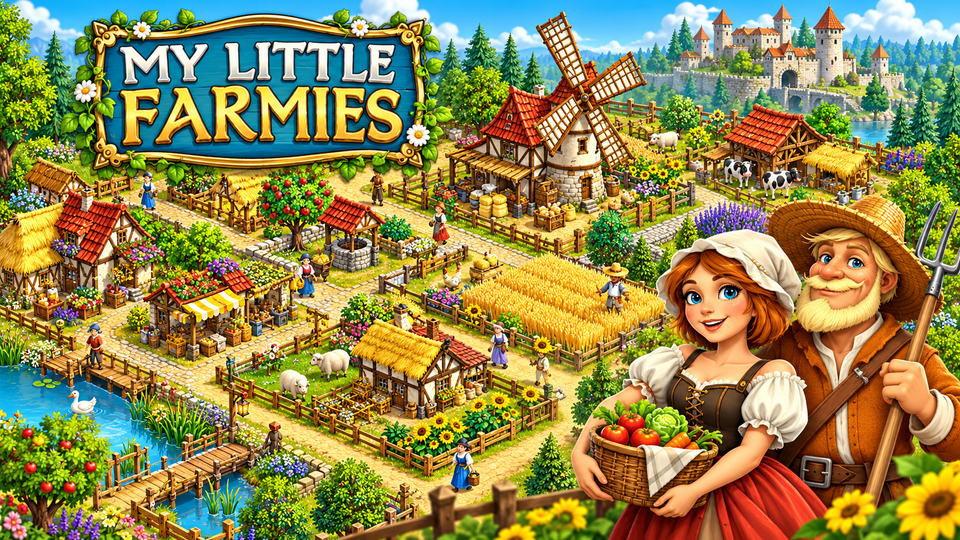
My Little Farmies is a medieval farming simulation where you grow crops, raise animals, build production chains, trade goods, and expand your village.
My Little Farmies is a farming and economic simulation where you develop a small medieval settlement into a larger agricultural village. You place fields and paths, grow crops, raise animals, construct workshops, process raw materials into finished goods, and sell products to customers. Progress gradually unlocks more buildings, production chains, animals, regions, and ways to expand your village.
The game was launched in open beta in March 2013 by upjers and King Art Games. Its central design combines village construction with resource management and production planning rather than focusing only on planting and harvesting crops.
Your farm begins relatively small. Early development centers on creating fields and paths before adding agricultural buildings, workshops, trees, animal pens, and other parts of the village. The important challenge is deciding how those elements fit together because many products depend on several production steps.
For example, wheat can be harvested from a field, processed into flour at a mill, and then turned into bread at a bakery. Other chains begin with fruit, livestock products, herbs, fibers, or additional agricultural resources. The official game material describes hundreds of products and numerous artisan workshops, making production management one of the main long-term systems.
Finished goods can then support quests, satisfy customers, or be sold. The result is a repeating management loop: produce raw materials, process them into more valuable products, sell or use those goods, and reinvest the resulting resources into village development.
Desktop versions are primarily controlled with the mouse. Browser-game listings document mouse interaction for selecting, placing, collecting, and managing farm elements.
Many raw materials become more profitable or useful after processing. The official My Little Farmies guidance separates products into field goods, animal products, manufactured goods, and special goods associated with unique buildings.
This makes production planning more important than simply planting the crop with the highest visible value. A useful field may feed several later buildings, while one missing ingredient can leave an entire workshop idle.
Consider what the next stage requires before deciding what to grow. If your bakery needs flour, you need enough grain production and mill capacity before increasing bakery output. Expanding only the final building in a chain does little when the earlier stages cannot supply it.
Agriculture is divided between crop production and animal husbandry. Official material confirms livestock such as chickens, geese, goats, and cattle, with breeding and animal products contributing to both quests and production.
Animals therefore serve an economic function beyond decoration. Their products can become ingredients for other goods, and breeding can contribute to specific objectives.
Craft buildings add another layer. Mills, bakeries, dairies, breweries, weaving-related production, and many other facilities transform farm output into increasingly specialized goods. The exact options expand significantly as the village develops.
Customers provide a way to turn inventory into income. Upjers' official strategy material also connects village decoration with customer traffic: decorations generate popularity points, and higher popularity attracts more customers who can purchase your products.
This gives decorations a practical role. They can improve the appearance of the village while also supporting the economy.
Variety matters as well. Official guidance notes that placing different decoration items can produce better popularity results than repeatedly using the same ordinary decoration. This gives you a reason to plan decorative areas rather than treating them as purely cosmetic additions.
My Little Farmies gradually introduces more systems as your settlement develops. Quests can ask you to grow crops, raise animals, produce specific goods, or complete other management objectives. The game also contains achievements, special buildings, events, additional regions, and other progression systems.
Following quests is useful when you are unsure what to build next. They often point toward mechanics or production chains that have recently become relevant to your stage of progression.
Long-term development extends beyond the original farm area. Current official information describes additional regions, travel features, caravans, special buildings, and other expansion systems that provide new objectives after the basic village economy is established.
My Little Farmies includes social and trading features. Players can visit or help friends and can also participate in guild-style cooperation. Official material describes guild buildings, merchant missions, contests, and rankings.
The marketplace also allows goods to be traded with other players. This can be useful when your village produces a surplus of one resource while another ingredient becomes a bottleneck.
Trading does not replace production planning, however. A village that consistently lacks a basic ingredient may benefit more from improving its own supply chain than repeatedly purchasing the same resource.
Before expanding a workshop, check every ingredient it needs. If the earlier parts of the chain cannot supply enough material, the new production capacity will remain unused.
Official guidance notes that many harvested materials can be processed further. When you have the appropriate buildings, turning raw goods into manufactured products can create more useful inventory and support additional customer orders.
Focusing too heavily on one plant can create shortages when several workshops require different ingredients. Maintain enough variety to support the production buildings you use most often.
Decorations contribute popularity, which can bring more customers into the village. If sales are important to your current progression, decorative development can support your economy instead of merely filling empty space.
Quests provide structured objectives involving crops, animals, production, and other systems. Completing them can help you expand in a more organized sequence rather than constructing buildings without a clear purpose.
If you enjoy farming, village development, and production management, try these related games on YaloGames.
My Little Farmies is a medieval farming and economic simulation where you build a village, grow crops, raise animals, create production chains, manufacture goods, and trade products.
Production begins with crops and animal resources and expands into processed goods created in workshops. A simple example is harvesting grain, milling it into flour, and baking that flour into bread.
Yes. The game includes livestock management and breeding, with animals producing resources used in quests, sales, and manufacturing.
Decorations provide popularity points. Greater village popularity can attract more customers who want to purchase your goods.
The game launched in open beta in March 2013 as a project from upjers and King Art Games. Upjers continues to operate and update the game.
My Little Farmies is built around more than expanding the size of a farm. Efficient villages connect fields, livestock, processing buildings, customers, trade, and decoration into one working economy. Keep the early stages of each production chain supplied, process resources when doing so supports your objectives, and expand only when your current village can support the additional demand. Over time, that planning turns a small medieval farm into a much larger settlement with increasingly complex production and trading options.
LIVE CHAT
No messages yet. Start the conversation.
Log in to join the chat.
Login