Loading game
Preparing player
Loading game
Ready to play
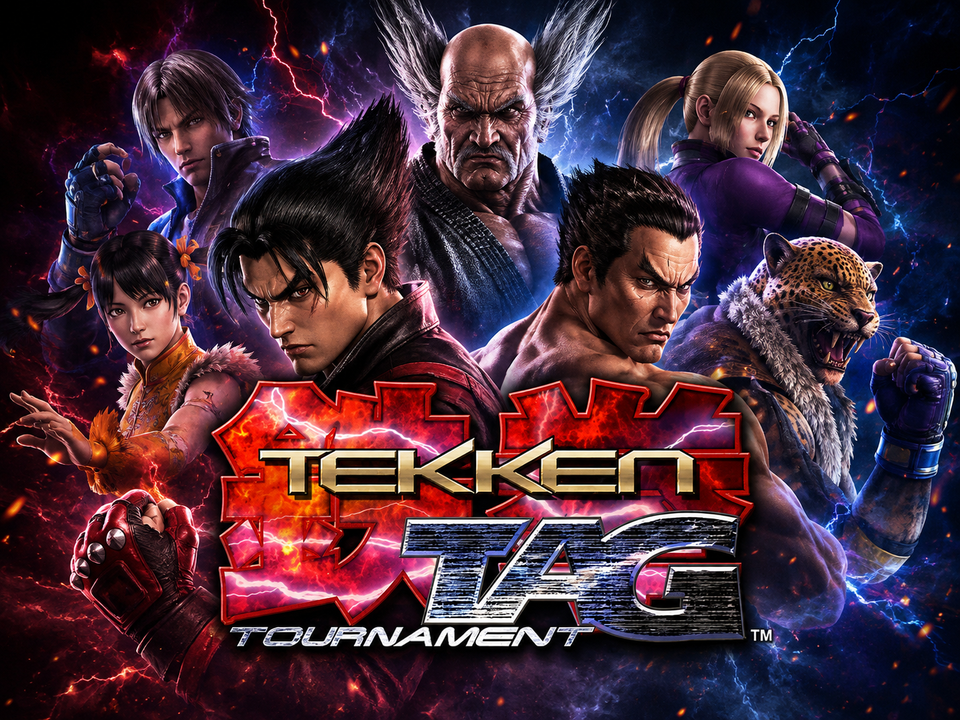
Tekken Tag Tournament is a 3D fighting game where you build a two-fighter team, tag between characters, manage health, and battle for the knockout.
Tekken Tag Tournament is a 3D fighting game from Namco built around two-character teams. Instead of choosing one fighter for the entire battle, you select a pair and switch between them during the match. The fighter waiting outside the arena can recover part of their lost health, so knowing when to tag is just as important as landing punches, kicks, throws, and combos.
The game originally reached arcades in 1999 before receiving a PlayStation 2 version in 2000. It brings together a large selection of fighters associated with earlier Tekken games while making team management the central difference from a standard one-on-one Tekken match.
A standard team consists of two fighters, but only one character fights at a time. You can press the Tag command to bring your partner into the arena and send the current fighter out.
Tagging has an important defensive purpose. A fighter resting outside the battle can gradually recover part of the damage represented by the recoverable section of their health gauge. That creates a constant choice between keeping your stronger character active and switching before they take too much permanent damage.
Unlike many tag-team fighting games, losing one member of your team can end the round. You cannot simply sacrifice one fighter and continue with the second at full strength. Protecting both characters therefore matters throughout the battle.
Tekken Tag Tournament rewards players who treat the two characters as one fighting system instead of simply choosing two favorites. Your second fighter is a resource for health management, matchup changes, and team-based attacks.
The original fighting system uses directional movement plus four attack buttons corresponding to the fighter's limbs, with Tekken Tag Tournament adding a dedicated Tag input. Browser keyboard mappings can differ depending on the emulator or game build, so the underlying arcade functions are more reliable than assuming a specific keyboard layout.
| Input | Action |
|---|---|
| Directional controls | Move, crouch, jump, sidestep, and position your fighter |
| Left Punch | Attack with the left arm |
| Right Punch | Attack with the right arm |
| Left Kick | Attack with the left leg |
| Right Kick | Attack with the right leg |
| Tag | Switch to your partner |
Tekken notation commonly refers to the four attacks as 1, 2, 3, and 4: left punch, right punch, left kick, and right kick. The Tag command is frequently represented as 5.
The tag mechanic changes how you should manage a fight. Leaving one character active until their health is almost empty can put the entire round at risk because a knockout of either team member is enough to lose.
A safer approach is to recognize when a fighter has accumulated recoverable damage and create enough space to switch. Once outside the battle, that character can regain part of the recoverable portion of their life bar.
However, tagging carelessly can also be dangerous. Your incoming fighter needs time to enter the arena, so repeatedly switching while the opponent is already attacking can give them an opportunity to pressure the new character.
Tekken Tag Tournament includes techniques that involve both members of a team rather than limiting tagging to simple character changes. Tag throws can bring the partner into a throw sequence, while compatible characters can have special team interactions.
The game also supports tag combinations in which a partner enters after an appropriate launcher, allowing the second fighter to continue the sequence. This makes team selection relevant beyond individual character strength. A pair that you understand well can make transitioning between attacks much easier.
Tekken Tag Tournament brings back fighters associated with earlier entries in the series. The roster includes recognizable characters such as Jin Kazama, Kazuya Mishima, Heihachi Mishima, Paul Phoenix, Nina Williams, King, Hwoarang, Ling Xiaoyu, Yoshimitsu, Eddy Gordo, Jun Kazama, Ogre, and many others.
Do not choose a team only because both characters have attacks you like. Consider whether you can comfortably switch between their movement styles and command sets during a fight.
For a beginner, two characters with familiar basic attacks may be easier to manage than constantly adjusting between fighters with very different stances or specialized movement.
One of the biggest differences between Tekken Tag Tournament and a standard Tekken battle is that health management applies across two fighters.
Imagine your first fighter has lost a substantial amount of health but is still controlling the opponent. Continuing the attack may produce a knockout, but taking one counter-combo could also end the round. Tagging gives that fighter an opportunity to recover some damage while the partner takes over.
This makes your health bars part of your strategy rather than simply indicators of how close each character is to losing.
Do not wait until a character has almost no health remaining. A single launcher or strong combo may remove your chance to switch. Tag while you still have enough health to survive an unexpected hit.
A tag is easier to manage when the opponent is not directly beside you. Knock them away, use their recovery time, or reposition before bringing in your partner.
Launch attacks are important because they create opportunities for airborne follow-up hits. Find at least one dependable launcher for each character and learn a short follow-up sequence rather than attempting complicated combinations immediately.
If you understand only one member of your team, you may struggle whenever that fighter needs to recover. Learn basic punishment, movement, and a few safe attacks with both characters.
Tekken's 3D movement allows you to shift sideways rather than fighting only forward and backward. Sidestepping can help against attacks that travel directly toward your current position, but mistiming the movement can still leave you vulnerable.
Your active fighter is not the only resource that matters. Check your partner's recovery before tagging again. Sometimes leaving the active character in for a little longer gives the resting partner more time to regain health.
Switching characters can also change the opponent's expectations. If your two fighters have different attack ranges or speeds, use the transition to change how you approach instead of immediately repeating the same offense.
Tekken Tag Tournament first appeared in arcades in 1999. Namco later released an enhanced PlayStation 2 version in 2000 with upgraded presentation compared with the arcade release.
The PlayStation 2 edition also expanded the home experience with additional modes, including the well-known Tekken Bowl minigame. Browser versions based on arcade emulation may not contain every mode found in the PS2 release, so available options depend on which version is being played.
If you enjoy the close-range fighting, counters, and opponent-reading in Tekken Tag Tournament, try these combat games available on YaloGames.
For another game focused primarily on direct fighting, start with City Brawl or Tap Brawl. If you want combat with a less traditional movement system, Ragdoll Arena offers a physics-based alternative.
Tekken Tag Tournament was developed and published by Namco. The arcade version was released in 1999, followed by the PlayStation 2 version in 2000.
The standard tag format uses a team of two fighters. One character is active while the other waits outside the battle until you switch.
Yes. A character outside the fight can recover part of the recoverable section of their health bar, making timely tags an important defensive mechanic.
In the standard tag rules, losing all the health of one team member can end the round even if the partner still has health remaining.
Tekken uses four primary attack inputs: left punch, right punch, left kick, and right kick. Tekken Tag Tournament adds a dedicated Tag command for switching characters.
Tekken Tag Tournament adds a second layer of decision-making to Tekken's movement, blocking, throws, launches, and combos. Winning is not only about knowing the strongest attacks of one character. You need to manage two health bars, recognize safe moments to switch, understand both members of your team, and prevent either fighter from being knocked out. Once tagging becomes part of your normal strategy instead of an emergency action, the game's two-character battles become much easier to control.
LIVE CHAT
No messages yet. Start the conversation.
Log in to join the chat.
Login