Loading game
Preparing player
Loading game
Ready to play
Play Parchisi and race four tokens home using two dice, strategic captures, safe spaces, and blockades while planning every move around your opponents.
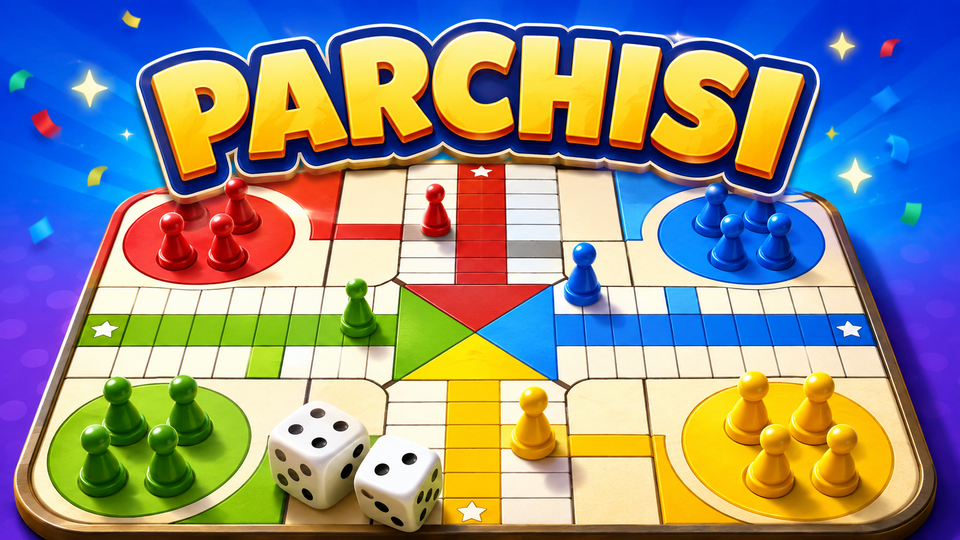
Parchisi is a strategy board game where each player controls four colored tokens and races them around a cross-shaped board toward home. Every turn begins with two dice, but winning is not based on luck alone. You must decide which token to move, when to capture an opponent, when to use a safe space, and whether forming a blockade is worth slowing your own progress. The first player to bring all four tokens home wins.
Each player begins with four tokens inside a starting area. Unlike some related board games where a six releases a piece, Parchisi uses 5 as the important entry number. A token can enter the track when one die shows 5 or when the available dice combination produces 5, depending on the legal move available.
After entering the board, tokens travel around their fixed route toward their home area. Your challenge is to advance all four pieces while dealing with opposing tokens moving through the same track.
Landing on an opponent's token can send that piece back to its starting area, while designated safe spaces protect tokens from ordinary captures. Two of your own tokens can also occupy the same position to create a blockade that prevents pieces from passing through.
Because several tokens may be available to move from the same dice roll, the important decision is often not how far you can travel, but which token should receive that movement.
Browser versions of Parchisi use simple point-and-click controls. The documented web controls require you to roll the dice, select the available die value or values, and then choose the token you want to move.
The game handles movement according to legal board positions, so some tokens may not be selectable for a particular roll.
One of the first strategic problems in Parchisi is deciding when to introduce additional tokens. A token cannot progress while it remains in the starting area, so early rolls of 5 are valuable opportunities to increase the number of pieces you can use.
Having several tokens on the track gives you more choices. One can push toward home, another can stay close enough to threaten captures, and others can be positioned around safer parts of the board.
However, moving every token forward equally is not always ideal. Sometimes advancing one piece aggressively creates pressure, while in other situations spreading your tokens makes it harder for an opponent to disrupt your entire position.
If your token lands on an opponent's token in a position where captures are allowed, the opponent's piece is returned to its starting area. That can erase a substantial amount of their progress.
Before choosing a capture, consider what happens afterward. Moving into an opponent's space may eliminate one threat but leave your own token vulnerable to another piece on the following turn.
The strongest captures therefore do two things: they delay an opponent and leave your token in a position that is difficult to punish immediately.
Parchisi includes marked safe spaces where ordinary captures are restricted. These positions can be valuable when an opponent is approaching from behind or when you need somewhere to hold a token while advancing another piece.
Do not treat a safe space as a reason to stop indefinitely. A protected token that never moves is still not reaching home. Use safety to manage risk, then continue advancing when the board gives you a favorable opportunity.
A blockade is created when two tokens belonging to the same player occupy the same board position. Other tokens cannot simply pass through that occupied position, allowing the blockade to interfere with an opponent's route.
This can be particularly useful when opponents are grouped behind you. Instead of allowing them an open path, a blockade forces them to wait until the position changes.
There is a tradeoff. The two tokens forming your blockade are not making independent progress while they remain together. A blockade is strongest when it delays important opposing pieces; keeping one active after it has stopped serving a purpose can slow your own race.
Rolling the same value on both dice can provide another roll after your legal moves are completed. This creates opportunities to make several moves during the same turn and can quickly change the board position.
When doubles appear, avoid automatically pushing your leading token as far as possible. Extra movement may be more valuable for bringing another token into a useful position, creating a blockade, escaping a threatened square, or preparing a future capture.
Completing the route requires precision. A token cannot simply move beyond its finishing space; it needs the exact movement required to reach home.
This makes the final part of the board different from the open track. A token sitting close to home may be safe and nearly finished, but a different piece might still be the better move if your current dice cannot complete that token's route.
Leaving most of your pieces at the starting area limits your choices. When an early 5 gives you the opportunity, introducing another token can give you more ways to use future dice and makes your position less dependent on a single piece.
Your most advanced token is not automatically the best token to move. Before pushing it farther, see whether another piece can land on an exposed opponent. Sending a rival back to the beginning may be more valuable than gaining a few additional spaces.
If an opposing token is within striking distance, compare your available destinations. Moving onto a protected space can preserve the progress you have already made instead of giving the opponent an easy capture.
Two tokens together can stop movement, but tying up two of your own pieces has a cost. Form a blockade when opponents actually need to cross that position, then be ready to separate the tokens when maintaining the wall is no longer useful.
Sending one piece far ahead can produce quick progress, but it also makes a capture especially costly. Advancing multiple tokens gives you alternatives when one route becomes dangerous.
As a token approaches home, remember that it requires the correct number to finish. Avoid basing your entire turn around a piece that cannot legally use the current dice when another token can make productive progress elsewhere.
If you enjoy the planning and decision-making in Parchisi, try these strategy and puzzle games available on YaloGames. The links below are taken from the YaloGames game sitemap.
For another turn-based challenge where every decision changes the next move, start with Trap the Cat. If you prefer pure puzzle strategy, 2048 is another strong option.
The objective is to move all four of your tokens from their starting area, around the board, and into home before the other players complete their pieces.
A 5 is used to bring a token onto the board. Depending on the legal dice combination, this can come from one die showing 5 or a combination totaling 5.
A blockade is formed when two of your tokens occupy the same position. It prevents tokens from passing through that space while the blockade remains in place.
When a legal capture occurs, the opponent's token is sent back to its starting area and must begin its journey again.
Yes. A token must have the exact required movement to enter its final home position.
Parchisi combines dice rolls with meaningful decisions about movement, captures, protection, and blocking. Bringing all four tokens home requires more than pushing whichever piece is closest to the finish. Keep several tokens active, use safe spaces when opponents threaten a capture, build blockades only when they create a real advantage, and always consider how the current move changes your options on the next turn.
LIVE CHAT
No messages yet. Start the conversation.
Log in to join the chat.
Login