Loading game
Preparing player
Loading game
Ready to play
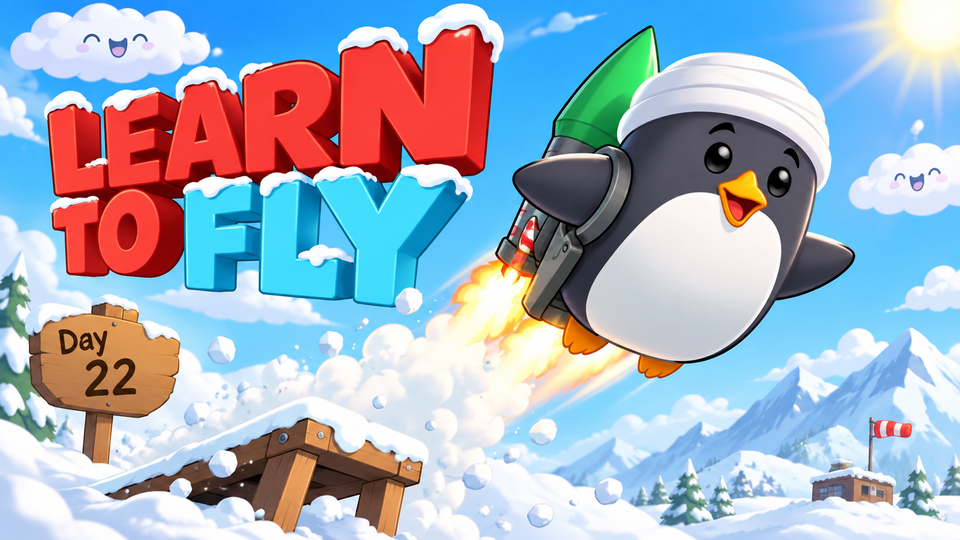
Learn to Fly is a physics launch game where you upgrade a penguin’s glider, ramp and rockets, manage flight angle, and work toward a 6,000-foot flight.
Learn to Fly is a physics-based distance game where a determined penguin repeatedly launches from an icy ramp and tries to prove that penguins can fly. Each attempt earns money based on your performance, which you spend on upgrades such as better gliders, higher ramps, improved acceleration, reduced air resistance, rockets, and additional rocket fuel. The long-term goal is to complete the flight challenges and eventually reach 6,000 feet.
The original browser game was released in 2009 and developed by Light Bringer Games under the lightbringer777 developer name. Its progression is built around repeating short flights, improving your equipment, and learning how angle, speed, altitude, and rocket timing affect distance.
Every day begins with your penguin sliding down a ramp toward the ocean. Once airborne, you control the angle of flight using the Left and Right Arrow keys. Tilting forward trades altitude for speed, while leaning backward can help convert speed into height.
Your first attempts are intentionally short because the starting penguin has limited equipment. After landing, the game rewards you with money according to your flight performance. You can then return to the upgrade screen, improve the penguin, and launch again.
Over time, stronger equipment allows you to stay airborne longer, reach greater speeds, climb higher, and travel much farther across the water. Rockets eventually add active propulsion, giving you another resource to manage during each flight.
The original game uses only a few keyboard controls, but small changes in angle have a major effect on your flight.
The original game has six main upgrade categories. Each improves a different part of the launch or flight rather than simply adding more distance directly.
| Upgrade | What It Improves |
|---|---|
| Ramp Height | Gives the penguin a higher starting position. |
| Acceleration | Improves speed gained while traveling down the ramp. |
| Air Resistance | Helps preserve useful speed during flight. |
| Glider | Improves the penguin's ability to remain airborne and travel farther. |
| Rocket | Adds powered thrust that can extend a flight. |
| Rocket Fuel | Increases how long the rocket can be used. |
The upgrades work together. A powerful rocket is less useful if you have very little fuel, while strong acceleration alone cannot provide a long flight if your glider loses altitude too quickly. Building a balanced setup becomes increasingly important as the distance targets grow.
Progress is divided across increasingly larger ramps. Each stage gives you performance targets involving distance, maximum altitude, speed, and flight time. Completing these achievements provides money and helps unlock later stages. The final 50-foot ramp includes the 6,000-foot completion target.
This means the game is not only about traveling as far as possible on every attempt. Some flights are better used to pursue a specific objective. For example, an altitude challenge may reward a steeper climb, while a distance attempt benefits from conserving speed and maintaining a more efficient glide.
Your penguin's angle determines how momentum is used. Pointing too far downward can produce plenty of speed but bring you back toward the water quickly. Tilting too far upward can gain height while draining forward momentum.
For longer flights, make smaller corrections. Build enough altitude to give yourself room, then settle into an efficient glide rather than constantly switching between steep climbs and dives.
The glider also has a speed range where it performs more efficiently. Max Games specifically warns that spending too long above a glider's effective speed range can cause speed to disappear quickly, so maximum speed is not always the same thing as maximum distance.
Once rockets are unlocked, holding the Spacebar activates them until you release the key or run out of fuel. Fuel is limited during each flight, so keeping the rocket active continuously is not always efficient.
Short boosts can help restore lost speed after climbing or keep the penguin moving efficiently during a long glide. If you consume all the fuel immediately after launch, you lose the ability to recover momentum later in the flight.
Rocket Fuel upgrades become increasingly valuable as your equipment improves because they extend the amount of time you can actively influence speed instead of depending entirely on gravity and the glider.
A long attempt depends on launch speed, lift, low resistance, and eventually rocket power. If one part of that chain is far weaker than the others, it can become the limit on your distance.
Do not force the same flight style onto every objective. A steep climb is useful when pursuing altitude, while a controlled glide is more appropriate for distance and airtime targets.
Use the booster when your speed begins falling or when additional thrust will meaningfully extend the flight. Saving fuel gives you a way to recover momentum after the initial launch.
Sharp climbs consume forward speed and steep dives reduce altitude quickly. Small corrections usually preserve momentum more effectively when the main objective is distance.
Going faster is not automatically better. If the penguin remains above the glider's efficient speed range for too long, extra drag can reduce the distance you gain from that speed.
If you enjoy upgrading a character or vehicle and gradually reaching greater distances, try these related games on YaloGames:
Your goal is to improve the penguin's equipment, complete flight achievements, and eventually travel 6,000 feet to finish the main challenge.
The original game includes Ramp Height, Acceleration, Air Resistance, Glider, Rocket, and Rocket Fuel upgrades.
Use the Left and Right Arrow keys to change the penguin's flight angle. Once rockets are unlocked, use the Spacebar to activate them.
Money is awarded after flights according to your performance, including factors such as distance, altitude, and time in the air. It can then be spent on upgrades.
The original game was developed by lightbringer777, associated with Light Bringer Games, and was published on Armor Games in May 2009.
Learn to Fly turns repeated launches into an optimization problem where every upgrade and small adjustment affects the next attempt. Improve your launch speed and glider, learn how to trade altitude for momentum, conserve rocket fuel for useful moments, and pursue the achievements that unlock stronger stages. Early flights may cover only a short distance, but an efficient upgraded setup can eventually carry the penguin all the way to the 6,000-foot goal.
LIVE CHAT
No messages yet. Start the conversation.
Log in to join the chat.
Login