Loading game
Preparing player
Loading game
Ready to play
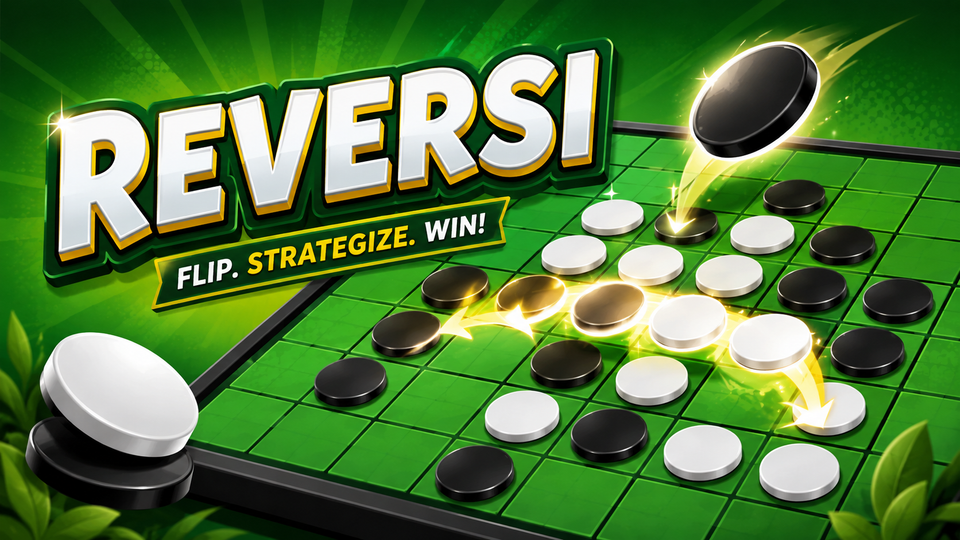
Play Reversi on an 8×8 board, trap and flip opposing discs, control valuable corners, limit enemy moves, and finish with the most pieces.
Reversi is a two-player strategy board game played on an 8×8 grid. Players take turns placing black or white discs, but every move must trap at least one opposing disc between the newly placed piece and another disc of the same color. Those trapped discs then flip to your color. The objective is to finish the match with more discs on the board than your opponent.
The Code This Lab browser version keeps the traditional Reversi rules while offering game-mode and difficulty selection. Its simple click-based interface puts most of the challenge into board control, move prediction, and deciding which discs are actually worth flipping.
A standard game begins with four discs in the center of the board: two black and two white. Black moves first. From that point forward, every new disc must capture at least one opposing piece by enclosing it in a straight line.
Captures can happen horizontally, vertically, or diagonally. A single placement can also trap enemy discs in several directions at once, flipping multiple groups during the same move.
This creates an unusual strategy problem. Flipping many discs immediately may look strong, but owning the most pieces in the middle of the game does not guarantee victory. What matters is the position those flips create for later turns.
The official Othello rules, which use the same fixed 8×8 placement system commonly used in digital Reversi, confirm that a legal move must flip at least one opposing disc and that a player without a legal move must pass.
The Code This Lab implementation uses clickable board cells, and published versions of the same game identify the mouse and left click as the desktop control method.
A legal placement must create a straight line containing one or more enemy discs between two of your own pieces.
Imagine a row containing one black disc, followed by three white discs and then an empty square. If Black places a disc in that empty square, the three white pieces are now enclosed between black discs. All three flip to black.
The same rule applies diagonally and vertically. If your new disc completes valid lines in several directions, every enclosed opposing disc in those lines must flip. You cannot choose to keep some of them in the opponent's color.
The four corner squares are among the most valuable positions on the board. Once a disc occupies a corner, it cannot be surrounded from the opposite side because the board ends there. That means the corner disc cannot later be flipped.
A corner can also help stabilize additional discs along the adjacent edges. Because of this, allowing an opponent an easy corner may have consequences that continue for several turns.
When considering a move near a corner, do not evaluate only how many discs it flips immediately. Check whether your placement gives the opponent a legal move directly into the corner on their next turn.
Edge squares can become useful because they have fewer directions from which they can be surrounded. However, edges are not automatically safe in the same way corners are.
An edge move that gives the opponent access to a nearby corner can be a serious mistake. Conversely, an edge supported by a corner you already own may become much harder for the opponent to change.
This is why board position matters more than simply accumulating pieces. A small number of secure discs can become more valuable than a large group that can still be flipped later.
You cannot place a disc on an arbitrary empty square. Every move must capture at least one enemy disc.
If there is no square where you can make a legal capture, your turn is automatically forfeited and the opponent plays again. You cannot choose to pass when at least one legal move exists.
This creates another tactical possibility: a strong board position can reduce the opponent's choices until they have no legal move at all, giving you consecutive turns.
The game finishes when neither player has a legal move. This commonly happens near the end of the board, but all 64 squares do not need to be occupied.
After play stops, count the discs showing each color. The side with more discs wins.
Because scoring happens at the end, an early lead can disappear quickly. A few late placements can flip entire rows and substantially change the final count.
A move that captures six discs may look stronger than one that flips only one or two. However, taking a corner creates a permanent piece and can strengthen nearby edge positions. Evaluate long-term board control before choosing the move with the biggest immediate flip.
Pay particular attention to squares directly beside a corner. Playing there can sometimes provide the opponent with the line they need to capture the corner on their next move.
Before placing a disc, look at the board that will remain after the flips. A move becomes more useful when it leaves the opponent with only a small number of legal responses.
Reversi scores only the final position. Owning most of the board halfway through the match can actually give your opponent many pieces to surround and flip later. Focus on useful squares rather than the current disc count.
It is easy to notice horizontal and vertical captures while overlooking diagonal lines. Before committing to a move, inspect all eight directions around the destination because the same placement can flip several groups.
After finding a legal square, ask what it creates for the other player. If your move opens a corner, strong edge, or large multi-direction capture, another legal option may be strategically safer.
The Code This Lab version includes a mode-selection screen and selectable difficulty. Published implementations of this version identify solo play against the computer and local two-player play, with Easy, Medium, and Hard computer difficulty settings.
Against the computer, lower difficulty is useful for learning what makes a move legal and recognizing basic corner opportunities. Higher settings make planning ahead more important because poor edge and corner decisions are more likely to be punished.
If you enjoy Reversi because each move changes the future shape of the board, try these strategy and puzzle games on YaloGames:
For another board-style strategy challenge, start with Trap the Cat. If you prefer planning several moves ahead and managing limited space, 2048 offers a different kind of positional puzzle.
Your objective is to finish the game with more discs showing your color than your opponent.
Your newly placed disc must trap at least one continuous line of opposing discs between itself and another disc of your color. Captures can occur horizontally, vertically, or diagonally.
Your turn is passed to your opponent. If you do have at least one legal move, you are required to play instead of voluntarily passing.
The standard game uses an 8×8 grid. The Code This Lab version also describes Reversi as a two-player game played on an 8×8 board.
The HTML5 browser version described here was developed by Code This Lab S.R.L.
Reversi rewards players who think beyond the number of discs flipped by the current move. Corners, secure edges, legal-move availability, and the options you leave for your opponent can matter much more than an early lead. Watch all eight directions before placing a disc, avoid handing away valuable corners, and plan around the position you want when the final moves are played.
LIVE CHAT
No messages yet. Start the conversation.
Log in to join the chat.
Login