Loading game
Preparing player
Loading game
Ready to play
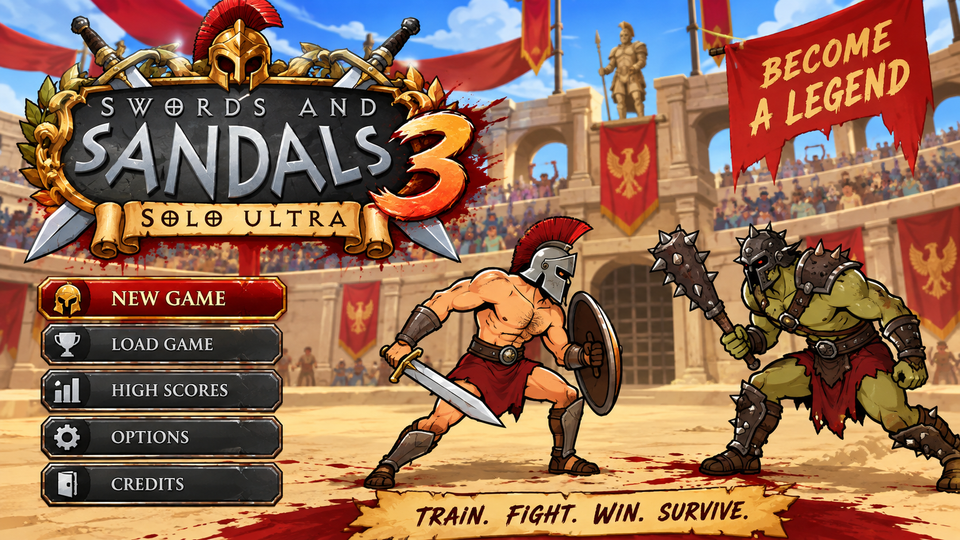
Swords and Sandals 3 is a turn-based gladiator RPG where you build a fighter, buy gear, learn talents, and battle powerful arena champions.
Swords and Sandals 3: Gladiae Ultratus is a turn-based gladiator RPG where you create a custom fighter, enter arena battles, earn rewards, improve your attributes and talents, and buy stronger weapons, armor, and spells. Combat is controlled through an action bar rather than real-time movement, so each turn asks you to choose between positioning, attacking, charging, taunting, magic, and other available abilities.
The original Solo Ultratus browser game arrived in 2008 as part of Oliver Joyce's Swords and Sandals series. The full solo campaign was built around 24 Arena Champions and a large collection of magical equipment, while the free browser release provided a more limited portion of the complete campaign.
You begin by creating a gladiator and deciding how your fighter should develop. Battles are turn based: you perform an action, your opponent responds, and the duel continues until one gladiator can no longer fight.
The battle toolbar provides several tactical choices. You can move closer or farther away, charge toward the opponent, taunt, attack with your equipped weapon, or use abilities available through your build. This makes distance important because different weapons and skills work better from different positions.
Winning fights advances your gladiator through the tournament and provides opportunities to improve the character. Between arena battles, equipment and character-development systems let you prepare for stronger opponents rather than entering every duel with the same statistics and gear.
The classic browser version is primarily a mouse-controlled game. Its menus, character creation screens, shops, inventory, and combat actions are selected through the interface rather than through real-time keyboard fighting controls. Kongregate categorizes the original Solo Ultratus release as mouse-only.
Swords and Sandals 3 gives the gladiator several attributes that support different styles of play. The main statistics include Strength, Vitality, Charisma, Intellect, and Agility. Character progression lets you invest points rather than forcing every gladiator into the same build.
The most effective allocation depends on what you actually plan to use. Investing heavily in spellcasting statistics while fighting almost entirely with melee equipment can leave valuable points supporting abilities that rarely affect your battles.
Character development goes beyond the basic statistics. The original game organizes talents into four schools: Warfare, Arcane, Theatrics, and Survival. Each school emphasizes a different part of gladiator combat.
Warfare supports weapon-focused fighters, while Arcane is aimed at magical development. Theatrics includes abilities connected to taunting and unusual sound-based weapons, and Survival contains defensive talents. You do not need to distribute talent points evenly; building around equipment and abilities you use frequently can create a more coherent fighter.
Equipment is an important part of progression. Swords and Sandals 3 contains melee weapons, ranged weapons, sound weapons, armor pieces, shields, and spells. Equipment can also appear with magical properties and different quality levels.
The original inventory system was designed around equipping gear directly onto the gladiator. Oliver Joyce described building a paper-doll-style inventory where weapons and armor could be dragged onto the character and changed between fights.
Do not judge equipment only by its appearance. A weapon must fit the way your gladiator fights, while armor has to provide enough protection without causing you to neglect the offensive or magical abilities your build depends on.
Turn-based combat gives you time to think before committing to an action. The game includes several kinds of attacks rather than one universal strike, and their risk or effectiveness can differ. Movement also consumes turns, making positioning part of the decision-making process.
If you depend on close-range weapons, reaching the opponent safely is part of the fight. A ranged or magical build can approach the same duel differently. Charging forward without considering the opponent's equipment can place your gladiator exactly where the enemy is strongest.
The full original Solo Ultratus campaign contains 24 Arena Champions. Oliver Joyce confirmed the number when releasing the single-player version, and the official Swords and Sandals site still describes 24 champions ranging from large fantasy creatures to mechanical opponents.
Arena Champions act as major progression tests. Reaching one is not only about having completed enough ordinary fights; your character also needs equipment and a build capable of handling stronger opponents. The Yeti Project became one of the better-known champions from this installment and also returns among the 24 classic champions in the modern Redux version.
If most of your attacks come from melee weapons, prioritize development that improves that approach. A focused build usually makes better use of limited attribute and talent points than distributing everything evenly without a plan.
The game contains a large pool of magical items. Before facing a tougher Arena Champion, review your current equipment rather than assuming the weapon and armor that handled normal opponents will remain sufficient.
Do not treat moving closer or farther away as wasted turns. Distance determines which attacks are practical, so reposition when it prevents an opponent from using its preferred range or helps your own weapon become useful.
Increasing damage alone does not guarantee victory. Vitality, armor, defensive talents, and positioning can give you enough time to use your stronger attacks instead of losing before your build reaches its potential.
Attributes and four separate talent schools give you many choices. Before spending points, consider whether the improvement supports your current weapon, magic, defense, or theatrical strategy.
The classic game is Swords and Sandals III: Gladiae Ultratus, released during the Flash era. A modern remake called Swords and Sandals 3 Redux was released in November 2025 by Whiskeybarrel Studios and eGames.com. Redux rebuilds the game while retaining the 24 classic Arena Champions and its turn-based gladiator foundation.
The browser version associated with the original game should therefore not be confused with Redux. Features documented specifically for the 2025 remake are not automatically features of the classic Flash release.
If you enjoy turn-based or arena fighting, character progression, and one-on-one combat, try these related games on YaloGames:
It is a turn-based gladiator RPG focused on creating a fighter, developing attributes and talents, buying equipment, and progressing through arena battles.
The classic browser game is primarily mouse controlled. You select combat actions and navigate menus through the on-screen interface.
The full Solo Ultratus campaign contains 24 Arena Champions.
Oliver Joyce is the creator of the Swords and Sandals series and announced the Solo Ultratus browser release on Newgrounds in September 2008.
No. Redux is a modern remake released in November 2025. The classic browser game is the original Flash-era Swords and Sandals III: Gladiae Ultratus.
Swords and Sandals 3 expands gladiator combat into a deeper RPG built around equipment, attributes, talent schools, positioning, and turn-by-turn decisions. Build your fighter around a clear combat style, improve the gear that supports it, and adjust your tactics instead of relying on one attack against every opponent. The stronger Arena Champions are designed to expose weaknesses in your build, so preparation between battles matters just as much as the choices you make inside the arena.
LIVE CHAT
No messages yet. Start the conversation.
Log in to join the chat.
Login