Loading game
Preparing player
Loading game
Ready to play
Play Snakes and Ladders, roll the dice across a 100-square board, climb ladders, avoid snakes, earn extra rolls with sixes, and race to the finish.
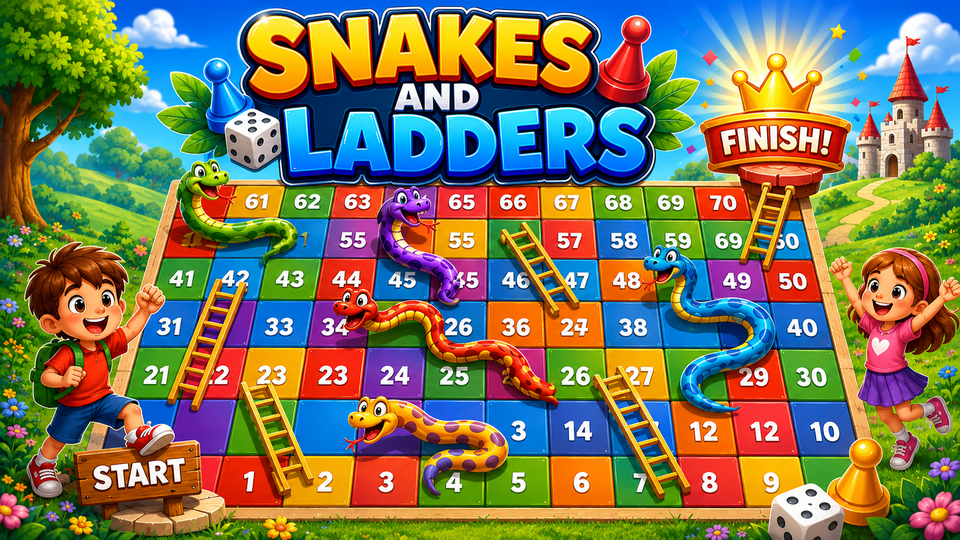
Snakes and Ladders is a digital version of the classic dice board game where players race across a 100-square board. Each turn, you roll the die and your piece advances automatically. Landing at the bottom of a ladder sends you higher up the board, while landing on a snake sends you backward toward its tail. The first player to reach the end wins.
The browser version developed by Code This Lab keeps the gameplay intentionally simple. There are no attacks, upgrades, or complicated movement controls. Your progress comes from dice rolls, with ladders creating major shortcuts and snakes capable of removing several turns of progress in a single move.
The board contains 100 spaces arranged along a route toward the finish. Players take turns rolling one die, and their pieces move according to the number rolled.
Most spaces simply become your new position. Special spaces change that immediately:
Code This Lab's own game documentation confirms the 100-square board, upward ladder movement, downward snake movement, and the bonus roll awarded after rolling a 6.
Game setup, player selection, color selection, the two visual modes, and the extra roll after a six are documented features of Code This Lab's HTML5 version.
The controls are deliberately minimal because movement is handled by the game after each dice roll.
Once the die has been rolled, the game moves your piece for you. You do not need directional keys to navigate the board.
A ladder is the most valuable position you can reach. When your piece finishes a move at the bottom of one, it travels directly to the ladder's upper end.
Some ladders cover only a small part of the board, while others can move you much closer to the finish. This means a player who is several spaces behind can suddenly move ahead after one favorable roll.
You must land on the ladder's starting position for it to activate. Simply traveling past the square during a larger roll does not give you the climb.
Snakes work in the opposite direction. If your move ends on the head of a snake, your piece slides down to the square connected to its tail.
A snake near the upper part of the board can be especially costly because it may erase a large amount of progress. This is what keeps the race unpredictable: a player who appears close to winning can suddenly fall behind, while another player may find a ladder and move forward quickly.
As with ladders, only the square where your move finishes matters. Passing a snake's head without landing on it does not send you backward.
Rolling a six does more than move your piece six spaces. In this version of Snakes and Ladders, it also gives you another dice roll.
That bonus can create a major swing in the race. One roll might move you onto a ladder, followed immediately by another roll that advances you farther. The opposite can also happen: the bonus roll may eventually place you on a snake.
Since dice results are random, the player cannot force this advantage. The important point is to recognize that your turn has not finished after rolling a six.
Code This Lab includes two visual versions of the game. The standard mode uses snakes and ladders, while the alternative replaces the snakes with chutes. The underlying idea remains the same: ladders move pieces upward and the downward obstacles send them back.
This alternative reflects the well-known Chutes and Ladders variation of the traditional board game without changing the central roll-and-move structure.
Snakes and Ladders is primarily a game of chance. Players do not choose how far their piece moves after rolling, and the digital version automatically handles the movement. Your position therefore depends largely on the dice and on whether the resulting square contains a ladder or snake.
This makes the game different from strategy board games where you choose between several possible moves. There is little opportunity to change the outcome of an individual turn, which makes sudden reversals a central part of the experience.
A six gives you another roll. Do not assume your turn has finished after your piece completes its first movement.
Ladders and snakes are triggered by your final position. The important square is where your piece lands after completing the dice movement, not every space it crosses on the way.
Even when you are ahead, look at the snake positions in the upper section of the board. Reaching the final part of the race does not guarantee victory if a later roll lands on a snake.
Large ladders and snakes can reverse player positions quickly. A substantial lead may disappear in a single turn, so the race remains open until somebody actually reaches the end.
In games with several participants, keeping track of turn order avoids confusion. This is especially important after a player rolls a six because that player gets another roll instead of immediately passing control to the next participant.
If you enjoy the simple board-game structure of Snakes and Ladders, these YaloGames titles offer other forms of turn-based thinking, puzzles, and accessible competition. The following game URLs are available in the YaloGames sitemap.
For another game played directly on a board-like layout, try Trap the Cat. If you want more decision-making than the dice-based movement in Snakes and Ladders, 2048 provides a more strategy-focused challenge.
The objective is to move your piece across the board and reach the final square before the other players. Ladders move you forward more quickly, while snakes send you backward.
Rolling a 6 advances your piece six spaces and gives you an additional dice roll.
Your piece must finish its movement on the lower end of a ladder. It then moves directly to the ladder's upper end.
Landing on a snake's head sends your piece down the board to the square at the snake's tail.
The HTML5 browser version described here was developed by Code This Lab. Its game documentation describes a 100-square board, player and color selection, Snake and Chute modes, and bonus rolls after rolling a six.
Snakes and Ladders turns every dice roll into a possible change in position. A ladder can carry you far ahead, a snake can undo several turns of progress, and rolling a six gives you another chance to move immediately. With simple mouse controls and automatic movement, the main objective remains clear from beginning to end: keep rolling until your piece reaches the top before everyone else.
LIVE CHAT
No messages yet. Start the conversation.
Log in to join the chat.
Login