Loading game
Preparing player
Loading game

Ready to play
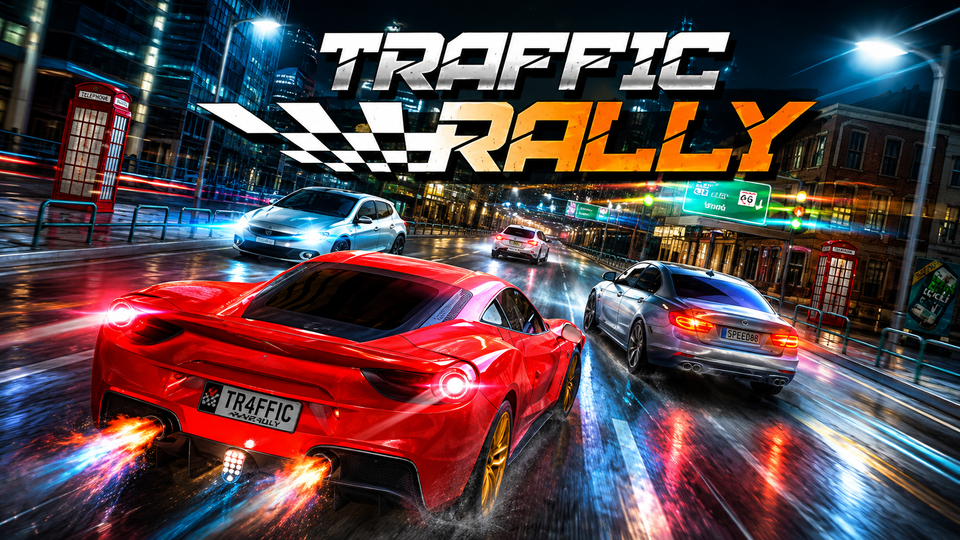
Traffic Rally is a highway driving game where you dodge traffic, clear Career missions, unlock 22 cars, tune performance, and chase longer runs.
Traffic Rally is a highway driving game built around speed, precise steering, and avoiding collisions in dense traffic. Instead of racing directly against another driver, you control a car through highways, city roads, and desert routes while completing objectives, passing vehicles, reaching checkpoints, or simply seeing how long you can keep driving without crashing. The game combines four driving modes with an 80-level Career and a garage containing 22 cars.
The difficulty comes from balancing speed with control. Driving faster can help with timed objectives and progression, but crowded lanes leave less time to react. As the Traffic Rally game becomes more demanding, choosing a clear lane, braking before a gap disappears, and making small steering corrections become more valuable than holding the accelerator constantly.
Each session begins by selecting your vehicle and one of the available modes. From there, your objective depends on the mode, but the fundamental challenge stays the same: navigate moving traffic without colliding while completing the current driving requirement.
Traffic Rally also includes control settings such as steering sensitivity, auto throttle, and an optional manual gearbox. On supported mobile versions, driving can use on-screen or tilt controls.
The four modes give the game more structure than a basic endless traffic racer. Career focuses on progression, Infinite rewards survival, Time Against puts pressure on your speed, and Free provides a lower-pressure place to understand the handling.
Career contains 80 levels with objectives that become more demanding as you advance. Challenges can involve checkpoints, distance, overtakes, speed, and different traffic conditions. Later stages also introduce changes in environment, time of day, and road configuration, so progressing through Career gradually exposes you to more difficult driving situations.
Infinite removes the structured Career ladder and turns the road into a survival challenge. Select the available environment and traffic configuration, then keep driving until a collision ends the run. One-way traffic is easier to read, while two-way traffic creates much faster closing speeds and requires earlier decisions.
Time Against gives you a limited driving window. The aim is to cover as much ground and perform efficiently before the clock reaches zero. Because every unnecessary slowdown costs distance, this mode rewards finding safe overtaking routes quickly instead of simply driving cautiously.
Free Mode removes mission pressure and is useful for learning a new vehicle. Use it to judge steering sensitivity, braking distance, camera angles, or tuning changes before returning to modes where mistakes affect your progression.
Traffic Rally includes 22 vehicles, starting with a basic car and progressing toward much more expensive high-performance models. Each vehicle has its own performance characteristics, so unlocking another car can change more than its appearance. Higher-tier choices provide increased performance potential for later Career challenges.
Buying every available vehicle immediately is not necessary. The starter car can handle early progression, which gives you time to accumulate money instead of spending every reward as soon as it arrives. When Career requirements begin exceeding what your current vehicle can comfortably handle, moving to a car with a higher upgrade ceiling becomes more useful.
The garage separates performance upgrades from finer tuning adjustments. Cars can be improved in three important performance areas: engine, brakes, and handling. Each has several upgrade stages, but individual vehicles have different maximum performance potential.
Engine upgrades help the vehicle build and maintain speed. They become increasingly useful in timed levels, but extra power also reduces your reaction window when traffic becomes dense.
Better braking gives you more control when a lane suddenly becomes blocked. This is especially useful when several vehicles occupy adjacent lanes and changing direction is no longer safe.
Handling upgrades support cleaner lane changes and make high-speed corrections easier to manage. For traffic-heavy stages, predictable steering can be more useful than adding speed to a car that is already difficult to control.
The tuning menu also provides adjustments such as gear ratio, ride height, and camber. Gear ratios allow you to favor stronger acceleration or higher maximum speed, giving you another way to adapt a vehicle to the type of challenge you are attempting.
Long steering inputs can move the car across several lanes faster than expected. When squeezing past traffic, tap the direction key for small corrections and straighten the car before making another movement. This gives you more control when the available gap is only slightly wider than your vehicle.
Do not make a lane change only because the next lane looks empty beside you. Check what is farther ahead first. Moving around one slow vehicle is useless if another car immediately blocks the new lane.
If cars occupy both neighboring lanes, reduce speed and wait for the traffic pattern to change. A controlled slowdown preserves the run; forcing a disappearing gap can end it completely.
Oncoming vehicles reduce your reaction time because both cars are closing the distance. Choose your exit lane before moving into opposing traffic and return to a safer lane before a gap becomes uncertain.
The E key does more than add a visual effect. The detailed game guide notes that flashing headlights can influence some vehicles traveling ahead, making the feature useful when approaching slower traffic. It should support your lane planning rather than replace it.
If nitrous is available, save it for a situation where additional acceleration has a purpose. A clear stretch, a timed objective, or an overtaking opportunity is more valuable than activating it while already boxed in by traffic.
There are four documented modes: Career, Infinite, Time Against, and Free. Career contains 80 progression levels, while the other modes focus on endless driving, timed performance, or unrestricted practice.
The Traffic Rally garage contains 22 vehicles. Cars differ in price and performance, and later vehicles offer higher potential for demanding stages.
Yes. Engine, brakes, and handling can be upgraded, while additional tuning options include gear ratio, ride height, and camber adjustments.
The detailed current game guide describes Traffic Rally as a single-player experience without online multiplayer modes.
Free Mode is the most practical place to learn because it removes normal mission pressure. Use it to understand braking, steering sensitivity, different cameras, and a newly unlocked car before attempting harder Career stages.
Traffic Rally works best when you treat traffic as the real obstacle rather than assuming maximum speed is always the goal. Read the road early, use small steering corrections, brake before lanes close, and upgrade the parts of your vehicle that solve the problems you are actually encountering.
Career provides the structured progression, while Infinite, Time Against, and Free let you approach the same driving mechanics from different angles. As your garage grows, the challenge shifts from simply surviving rally traffic to choosing the right car, tune, and route for increasingly demanding high-speed runs.
LIVE CHAT
No messages yet. Start the conversation.
Log in to join the chat.
Login