Loading game
Preparing player
Loading game

Ready to play
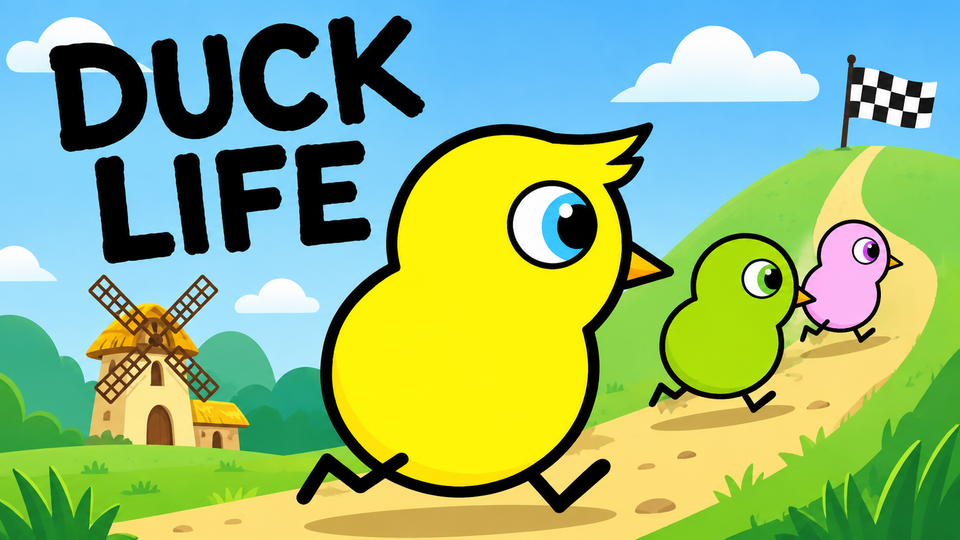
Duck Life is a training and racing game where you improve running, swimming, flying, and energy before guiding your duck toward the championship.
Duck Life is a training and racing game where you raise a young duck, improve its athletic abilities, and enter increasingly demanding races. Your duck does not become a champion through direct upgrades alone. You must complete separate running, swimming, and flying mini-games, feed it to increase energy, and decide when its statistics are strong enough to compete.
The story begins after a destructive storm leaves a farm in ruins, with a single duck egg remaining. By training the duck and winning races, you can earn the money needed to restore the farm. This gives every exercise a clear purpose: stronger skills lead to better race results, and better results move you closer to the final championship.
The Duck Life game follows a repeating cycle of training, feeding, racing, and improving. Training courses increase specific abilities, while races reveal whether your duck is ready for stronger opponents. Losing does not erase your progress, so a failed race is useful feedback rather than the end of the game.
The important distinction is that training requires player input, but races largely depend on the statistics you have built beforehand. Success therefore comes from preparation and resource management rather than pressing buttons faster during the competition.
Running training sends the duck forward while obstacles approach along the ground. Jump over each hazard and collect coins positioned along the course. Every successful attempt contributes experience to the running statistic, helping the duck move faster during races.
Do not jump automatically whenever an obstacle appears in the distance. Wait until it is close enough that the duck can clear it cleanly. Jumping too early may cause the duck to land directly in the obstacle.
During flying training, the duck glides through the air while gradually losing momentum. Move it upward or downward to gather coins and stay on a useful flight path. The course ends when the duck can no longer remain airborne, and the accumulated experience improves its flying performance.
Large vertical movements can waste distance and make nearby coins difficult to collect. Smooth adjustments are usually more effective because they preserve a controlled route through each group of coins.
Swimming training introduces obstacles both above and below the waterline. The duck must jump over surface hazards and dive beneath objects that block the lower route. Reading the next obstacle early is important because choosing the wrong direction can end the attempt immediately.
Use the visible shape and position of each hazard to decide whether to rise or dive. Avoid returning to the center too quickly when another obstacle is already approaching from the same side.
Energy determines how long your duck can continue during a race. Even excellent running, flying, and swimming statistics may not be enough when the duck runs out of energy before reaching the finish. Feed it regular seeds or stronger skill seeds purchased with collected coins. Blue skill seeds increase energy more efficiently than standard food.
The controls change between activities because each course develops a different skill. Running focuses on jump timing, flying uses controlled vertical movement, and swimming requires quick choices between surface and underwater routes.
The game does not provide one universal statistic that guarantees victory in every event. A useful approach is to raise each athletic skill gradually, attempt a race, and use the result to identify the weakest area. A course focused mainly on swimming may expose a low swimming level, while a longer mixed race may reveal insufficient energy.
Try increasing your main statistics in manageable intervals rather than training one ability far beyond the others. The later competitions combine multiple forms of movement, so a duck with one excellent skill and two weak skills can still lose.
Energy deserves additional attention before entering an important event. Coolmath Games recommends keeping energy considerably higher than the athletic statistics because the duck must have enough stamina to use those abilities throughout the race.
Coins are collected mainly through training and race rewards. Their most important early use is purchasing food, since energy directly affects whether the duck can finish a course. Saving every coin for cosmetic items may leave your athlete underprepared.
Winning races can also unlock colors, hats, and other appearance options. These items let you personalize the duck but do not replace training. Prioritize the upgrades and food that affect performance, then spend spare coins on customization once your essential statistics are in a strong position.
Avoid repeatedly training only the mini-game you find easiest. Later races can include running, swimming, and flying in the same course. Rotate between activities so one weak section does not erase the advantage gained elsewhere.
Check energy before attempting a new competition. When the duck performs well at the start but stops before the finish, more stamina is usually needed. Buy seeds and raise energy before repeating the same race.
Do not continue repeating a lost race without changing anything. Watch where the opponent gains distance. Falling behind on land suggests more running training, while losing ground in water indicates that swimming should be the next priority.
Coins help finance food, but one risky coin is rarely worth ending a productive training attempt. Prioritize survival when a coin sits directly beside a log, boat, iceberg, or other obstacle.
Regular seeds are useful when money is limited, while blue skill seeds provide a faster energy increase. Saving for the stronger seed may be more efficient before a difficult race, especially when stamina is the only statistic holding the duck back.
Duck Life and the wider series were developed by Wix Games, a UK-based studio strongly associated with duck-training and racing games.
The original game focuses on running, swimming, flying, and energy. The first three improve through playable training courses, while energy increases when the duck eats seeds.
Race performance is primarily determined by the statistics and energy developed beforehand. Your main responsibility is preparing the duck through training and feeding.
You can return to the farm, continue training, increase energy, and attempt the race again. Your existing skill progress remains available.
Its main genre is training and racing rather than mathematics. However, choosing upgrades, comparing statistics, and managing coins involve planning and basic numerical decisions.
Duck Life turns simple mini-games into a connected development system. Running, flying, and swimming practice determines speed, while seeds provide the energy needed to finish each race. Train the weakest statistic, manage coins carefully, and treat every lost event as information. A balanced duck with sufficient stamina has a much stronger chance of progressing from its first local race to the final championship.
LIVE CHAT
No messages yet. Start the conversation.
Log in to join the chat.
Login